SALF 2013 – Reporting Across Borders: India and Pakistan

Guest post by Sonal Tarneja


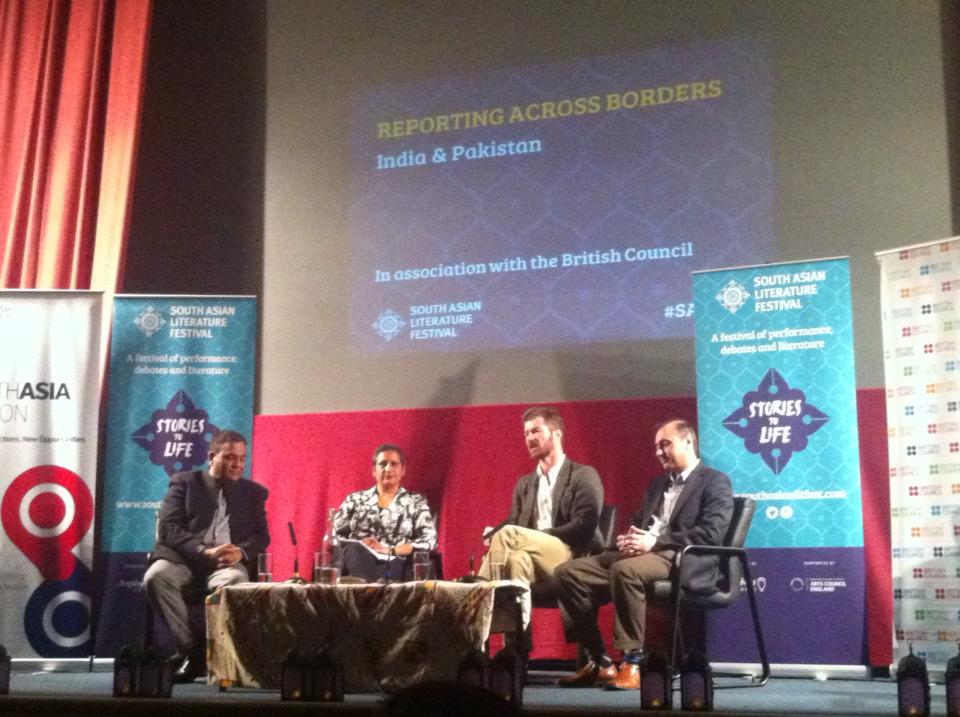
Panel: New York Times correspondent Declan Walsh, Executive President of the Times Group in India Rahul Kansal, and lawyer and journalist Farooq Bajwa.

Moderated by: Shreela Ghosh, South Asian Arts Director at the British Council.

Date: October 26th, 2013

Reporting across borders SALF


Starting off as a discussion on the state of reporting across the Indo-Pak border, this session delivered much more than it promised – it offered an insight into what’s going on on both sides of the border, the relevance of Partition today, and a contrast of attitudes, perceptions and ground realities.

Reporting, like most other exchanges across the border, is not easy. With just four Indian journalists – from across all publications – in Pakistan, and an unsaid number of Pakistani journalists in India, cross-border reporting is stifled and poor. What gets reported in India, then, is what sells – a reiteration of young India’s view of Pakistan as an imploding country – “trouble for India”. Whereas until the 1980s one got to see a positive glimpse of Pakistan, especially with television shows like Dhoop Kinarey, which were beyond their times compared to Indian offerings (or lack thereof), more recently news from across the border is unidimensionally and progressively about terrorism. Pakistan, on the other hand, is so absorbed with its own internal problems and near turmoil, and the threat from neighbouring Afghanistan, that India has slid down the list of top news items and priorities over the last 10 years.

So is Partition even relevant today, or have both sides moved on? With 60% of the Indian population less than 30 years old, Partition isn’t very relevant in India today. It’s a part of history. In Pakistan, however, the Partition is about the unfinished business of Kashmir, though not in the top of the current national agenda. With the focus of animosity shifting towards the US since 2001, India is considered far less “bogey” than it used to be. Pakistanis now don’t see India as a threat, and in fact 60-70% want better relations with India.

That said, certain establishments – reportedly the military – are still holding firm. The latest Pakistani film ‘Waar’ reveals an interesting insight. It’s interesting that for a country torn by war, Pakistan’s first attempt at a “Bollywood style blockbuster” portrays India as the trouble maker, when, as a matter of proportion, the issue lies elsewhere.

Overall, on a people to people level, cultural exchanges such as open access to Bollywood films in Pakistan, and consumption of Pakistani music and performances in India, is giving birth to a positive attitude on both sides.

So what is the solution for long-lasting peace? Increased trade can improve things, and is bound to eventually, but the question is when. Even under existing agreements, trade can almost be quadrupled. But with artificial barriers (or “silly bottlenecks”) such as requiring the other side to park its trucks half a kilometer from the border because ‘the road conditions don’t allow for heavy trucks’, a lot more needs to be done. Elimination of tit for tat barriers, easier and less stringent visa requirements, and even helping the other side overcome onion shortages (!) are a great place to start. In the meantime, ‘Aman Ki Asha’, a peace initiative between the Jang Group of Pakistan and the Times of India, is trying to make a small difference.


Sonal lives in London and has a deep interest in South Asian history, with specific focus on the Partition. Her personal blog can be found on sonaltarneja.blogspot.com.


(This is independent coverage of an event at the South Asian Literature Festival in London. DWL is not responsible for the views expressed or relayed in it.)


What We Talk About When We Talk About Love

For the last 5 weeks, I have been teaching a poetry course through Desi Writers Lounge. It is a basic, sweeping course, titled “Elements, Themes, and Form.” We have talked about things like imagery, abstraction, figurative language, and the salient themes in poetry: self-portraits and, begrudgingly, love. This is not to say that poetry is limited to these two themes. On the contrary, I feel it is the most natural form of expression for any emotion. However, when one first starts to dabble in poetry, one is, more often than not, naturally drawn towards these two themes.

For the course, I have re-read some of my favorite poems and have had the pleasure of composing discussion questions based on the weekly reading. Last week we were exploring the theme of Love and Desire, and it corresponded with the highest number of assigned readings for the entire course. We read the following poems, which I highly encourage everyone to get their hands on, like, right now.

– Li-young Lee, “This Room and Everything in It”

– Joy Harjo, “The Real Revolution is Love”

– Sandra M. Gilbert, “Anniversary Waltz”

– Richard Ronan, “Soe”

– A. Loudermilk, “Daring Love”

– Chitra Divakaruni, “Sudha’s Story”

– Sheila Zamora, “In Return”

– Nhan Trinh, “Country Love”

All three of the course participants were also given homework, which was to write an original poem on the theme of love and desire. It was an open prompt and they were told to use the week’s reading as inspiration.

I got three very different poems.

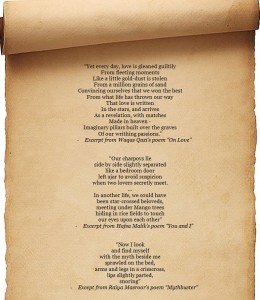
Waqas A. Qazi wrote a jaded poem titled “On Love.” He was also not a fan of the readings – a curious response as he has appreciated all the assigned poems in the past. “I don’t quite know what to make of this week’s readings. I think one needs to be in a specific kind of mood to read and appreciate romantic poetry. This has not been one of those weeks. Hence my interpretation of these poems may be quite subjective. I don’t think there is a poem here which has really impressed me yet,” wrote Waqas. I am not going to lie – the bitter honesty in his words crushed me! Lee’s “This Room and Everything in It” is one of my favorite poems and I have used it as a motif to write a poem myself, which in my opinion, is some of my more polished work.

The response from the other two course participants was encouraging. Hafsa Malik wrote, “Okay, so love is a hackneyed theme, I agree, but to sound like a bit of a cliché myself, I am a hopeless, hopeless romantic. So I really love good love poems! You should have totally included Brown Penny in this [by the way], Noor. A gem, that poem is.” I agree. I should have included “Brown Penny” by Yeats, a poem that remained my signature on the Desi Writers Lounge forums for a few years. Hafsa wrote a poem about love and longing, beautifully evocative, titled “You and I.”

Raiya Masroor also said something after my own heart. “The poems in this selection deal with this clichéd theme in a realistic way. Most of the poems are about real love, loss, and desire instead of focusing on the beloved, his/her characteristics, and the waiting/pining for a lover. They deal with the concept of love in real lives.” Raiya really hit the nail on the head, I think. It’s the simple and frightening reality of love in these poems that makes them so compelling to read, in my opinion. Raiya’s own poem, a remarkably well-written piece about finding bliss in a relationship, seeing love in the simplest of acts once you discover and possess it (like the snores of your partner), was absolutely brilliant and a testament to the fact that not all thematic poems on love have to be long, torturous, drawn-out cliches. She intriguingly titled her poem “Mythbuster.”
POEMS

Excerpts from poems written by DWL Poetry Course participants. Click to enlarge.

Reading through the work of these three poets, each with a very different approach towards and perspective of love and its perils, I thought about the poems I have written on the subject. They have been few and far between, but they have definitely portrayed more of the weary frustration reminiscent of Waqas’s “On Love” rather than Hafsa’s longing in “You and I,” and they have certainly never been as obviously blissful as Raiya’s “Mythbuster.”

Last week we read about love, we talked about love, but I have come to believe that all poetry ever written has barely just scratched the surface of this compelling theme. In the pleasant deluge of poetry on love and desire that I immersed myself in last week, I kept circling back to the two lines of wisdom that (to me) represent a universal truth about this reckless emotion, penned by the great W.B. Yeats:

“Ah, penny, brown penny, brown penny

One cannot begin it too soon.”

So, in talking about love, I did not discover anything more than I already knew. And I was reminded of the fact that I really don’t know much about love at all.

Looking through my work from years ago, my very first poetry workshop to be exact, circa 2006, I found two short poems in an old chapbook. They must have been written in response to a similar prompt, a prompt related to love, which is why the poems are so succinct and, quite frankly, stiff-necked, opinionated, rigid, but at the same time, they are fascinating specimens that bring to light the state of mind of the 21-year-old Noor.

I am going to leave you with these specimens now. Not my best work by any stretch of the imagination, but here it is for what it’s worth. Two poems from October 2006.

Crossroads

We are at the place

where it is easier to hate

than to love each other.

Synonyms

He calls me,

I answer,

as much out of duty

as out of love.

 And after the sheer humiliation that comes with posting the two poems above, I am compelled to post something recent that is more representative of my present poetic voice, loosely related to the theme under discussion.

Hand in Hand

we are on our travels with
undercurrents of conversation,
promises cracked through the middle,
wrapped in the cloth that blinds us

there are so many realities of us,
a decade full of crests and troughs,
a steady progression of waves and bodies,
flesh loosening,
aging,
the crow’s feet around my eyes,
the subtle lethargy in my breasts,
and you look new still

you have come and gone
like a song that disappears
as a car with the radio blaring
passes us by on the open road

now, after sheltering my body
in the fetal position,
broken wholly in some places
and incompletely in others,
I wonder if dignity,
(the price of this compromise)
is to be eaten for dinner
to fill up my stomach
that knows no sin,
and if the measure of my affection
is how much I have cried

let’s take a diverging walk now –
some furlongs on foot
and you will meet a small gap in the asphalt,
we can fall through it and come out
on the other side –
one lurch and a blink,
and we will cross oceans and icebergs
to be reborn –
ourselves again
in the native land,
our eyes feasting
on cotton crops and sugar cane and
tilled fields

you say nothing –
it’s just as well,
here, on our journey,
language has no power
and we haven’t crossed over yet

two thousand ears of corn,
two thousand ears
scattered in the ocean
their tympanic membranes
vibrating still,
and voices taking shape,
murmuring like ghosts lazing on the waves

the darkest place I have been to
is this ocean at night, with you,
we are on our travels still,
we are on our travels

Disclaimers

1. The title is stolen from Raymond Carver’s excellent short story, What We Talk About When We Talk About Love. I highly recommend it!

2. This post originally appeared on the author’s personal blog, Goll Gappay – Little Matters That Matter.

Notes

1. If you’d like to join Desi Writers Lounge, a platform dedicated to coaching new writers and poets, please complete the registration form here. The writing sample is important. We do screen our applicants, so please be sure to provide one.

2. All of us at Desi Writers Lounge work very hard to create a bi-annual online literary magazine called Papercuts. Browse through our hard work and let us know what you think on the Desi Writers Lounge Facebook Page or leave comments on the webpage.

3. If you haven’t done so already, like us on Facebook and follow us on Twitter
 

Interview: Saad Shafqat on his debut novel ‘Breath of Death’ – a medical thriller based in Karachi.

Saad Shafqat is a neurologist by profession, a cricket writer/columnist and the author of the medical thriller, Breath of Death. We caught up with him recently to talk about the book, terrorism, and his future projects. Breath of Death is his first novel.

How did you decide to write this novel?                                                      

breath-of-death290x450

I’ve always enjoyed telling stories and sharing anecdotes, and for a long time I’ve also felt drawn to the craft of writing. I felt an urge to write this novel at least partly because I wanted to combine these two inclinations. I’d been writing on cricket and on social issues for a while, but I hadn’t done fiction before. I think if there is a story inside you, it has to come out somehow. It’s in our nature as human beings, and it has the effect of easing a burden. I guess at some level I just felt there was a story somewhere inside and I had to express it.

The story is based in Boston and Karachi, the action takes place in a hospital and the protagonist is a neurologist. Did your professional surroundings inspire you?

Yes, very much so. A hospital is really a miniature human society, with life-and-death drama at its core. There is no shortage of emotional triggers. On top of that, physicians spend a great deal of time in their professional milieu, so there’s constant exposure – I would even say bombardment – from the daily realities of the medical experience. The setting and surroundings of our work have the potential to play havoc with the mind, and it seems some of that gets translated into fiction-writing. Many novelists have in fact been doctors (there’s even a Wikipedia page dedicated to that category).

You’ve written about the taboo of pirs and fakirs, not once but twice in the book. Is this something that you’ve observed in your patients?

Yes we see this from time to time. It’s very depressing, because it’s all about deception and exploitation, and about innocent people getting badly misguided in the search for good health care. I think it’s also true that these negative influences are on the wane. There’s an increasing degree of transparency in our society now, with the proliferation of media, mobile phones, internet, etc. Patients and families are becoming savvier and better informed.

 Religious extremism and anti-American sentiment seems to be at the heart of most terrorist operations. Both the villains (if we can call them that) Malik Feysal and Hamza Kadri also display these feelings. But so do the doctors at Avicenna Hospital. Were you making a larger point about American foreign policy by showing this?

I think there’s a lot of ambiguity in the way we relate to America and its various aspects, and I’ve tried to portray that in the book. America’s foreign policy and military outlook, for example, are deeply unpopular with everyone, and this sentiment cuts across socioeconomic, ethnic, cultural, and even international barriers. Yet there is also no denying that there is much about American life and society to admire and emulate – freedom, justice, prosperity, intellectual ferment. This is what makes America fascinating, and draws us to America as an iconic idea. I also think that, as a writer, it is important to create ambiguity. You want to try and keep the reader guessing whose side you’re on. When discussing America, that kind of approach comes naturally.

 As a first time author, what kind of publishing hurdles did you face?Pic for Mail Today

Getting fiction published by a first-time author is uphill anywhere, but perhaps especially so in Pakistan, where there is no credible fiction publisher. The only multinational publisher with local offices is Oxford University Press, and while they’re doing a terrific service through the literature festivals in Karachi and other cities, they’ve stopped accepting fiction from Pakistan. This is in marked contrast to India, which has local presence of some of the big publishing houses such as Penguin and Random House. So you naturally have to look outside the country, and many of us have focused on New Delhi, which has fast become the publishing center for desi fiction in English. I initially sent out my manuscript to literary agents in the US and UK, but kept getting rejected. A few did give encouraging comments, which was very heartening, and that strengthened my resolve. Eventually I started exploring options in India, and got lucky with Wisdom Tree, an emerging Delhi-based publisher who decided to take a chance.

 How has the response been to the book so far? 

It’s been very encouraging. The book launch received coverage in the local press, which was very flattering. In Karachi, the book sold out from Liberty Books a few times already, and it’s also done well on internet outlets like Amazon, Goodreads, and Biblio. There was a very positive review on the Dawn website from Fatema Imani, although the one in Dawn’s print edition was more lukewarm. I’ve been told a couple of other reviews are in the works. I was also very pleasantly surprised to see an endorsement for the book from John Upton, a popular science blogger based in the US. He called it “an exciting story” and a “well-composed thriller.”

John Grisham, being a lawyer, writes law thrillers. Is it safe to assume that you will continue writing medical thrillers?

I’ve started work on a dark comedy in a medical setting. This one too is based in Avicenna Hospital, but the central character is a woman. She’s a trauma surgeon who gets into some trouble, and then she has to get out of it. Asad Mirza, the protagonist in Breath of Death, might come in at some point, but peripherally. The series I would like to create is on the unpredictable nature of life in Karachi, with Avicenna University Hospital as the common theme. Medicine is full of drama, and when you situate it in a city like Karachi the possibilities are endless.

What does it take to make a book?

Guest post by Saira Haqqi


I have a confession to make.

I judge books by their covers.

To be more exact, I judge them based on how they are made.

This probably seems inexplicable. Whereas books were originally luxury items, created for the enjoyment of a wealthy few, they are now so common that we hardly give their binding a second thought. After all, they’re just churned out by machines, aren’t they? Isn’t their content more important, at the end of the day?

And yet, we are all aware of books that have been profoundly unsatisfying to read. That obese textbook that lurched out of its covers within a few weeks, that ornate tome that refused to open far enough to allow one to actually read it, or that paperback that disintegrated into a pile of loose papers before it had been read once – we’re all familiar with books that just didn’t succeed as books.

Do books have this luxury? They do not.

Do books have this luxury? They do not.

I’ve had occasion to think about all of these things this year, since I am spending my summer binding books the old-fashioned way – by hand.

***

The best – and worst – thing about bookbinding is that it feeds into relentless perfectionism. A friend and mentor once warned me that when making a book, you have to get everything just right from the beginning or the book will be a complete flop. Her words were, unfortunately, quite true, and become positively intimidating when you think of all the steps involved in making a book.

Since I’m making blank books, I (thankfully) don’t have to worry about printing anything. I start by cutting and folding large sheets of paper into what are called ‘gatherings’ – a group of pages folded together. These are pressed in a contraption called a “book press” for several hours, if not overnight, to squish them as flat as possible. Then the gatherings are cut – one by one – more exactly to size using a “board shear” – a lovely little machine that could easily slice off a finger, if not an entire hand. For the books I’m making these days (twenty gatherings, eight pages per gathering) this takes about an hour and a half per book.

Saira Haqqi blogpost 1

One gathering – nineteen to go!


Then, each of the gatherings is marked with a series of holes through the center fold, which are then used to sew the book together, a gathering at a time.

As you can see, this is a very neat process.

As you can see, this is a very neat process.


Then the pages can be trimmed again; the edges decorated with paint or gold; the spine left flat or rounded (a process that involves a hammer and muscles you did not know you had); covering material prepared (and therein lies a tale); hard-cover boards cut; innumerable things measured, re-measured, mis-measured, and re-measured again; and the whole thing put together, usually with an air of washing one’s hands entirely of the wretched thing.

Two books awaiting covering. Only about a four hours of work to go!

Two books awaiting covering. Only about a four hours of work to go!


To say that the affair is an exercise in frustration is putting it mildly. It’s physically exhausting – I’ve spent almost every day these past few weeks standing and applying some kind of pressure with my hands and arms. The whole thing involves innumerable pointy, dangerous tools that result in all kinds of fun scars to show one’s friends, and results in a wonderfully expanded vocabulary of a type that unfortunately cannot be printed in these august pages due to the fear of ruining the innocence of young eyes.

The closest I shall ever get to practicing medicine.

The closest I shall ever get to practicing medicine.


And yet! There is a certain joy to creating something all by oneself that can be explained by any five-year-old who has had a drawing stuck up on the fridge. And there is a sense of accomplishment to mastering skills that, no matter how easy they may sound, take years of practice to accomplish successfully. Simply cutting paper can be difficult when you have to cut it to an exact dimension – not a millimeter more, not a millimeter less.

It helps that sometimes the books look pretty, too.

It helps that sometimes the books look pretty, too.


***

So the next time you go into a bookshop – or simply glance across your bookshelf – take a moment to think about the way in which the books have been made. Think about the miracle that brought them to you in this format – that history of people who, like me, poured their body and muscles into creating this object to further the spread of knowledge. And marvel that we ever got this far.


Saira is currently enrolled in the New York University graduate program in art conservation, where she is specializing in the conservation of library materials. You can follow her personal blog at sairarias.wordpress.com.


Show some spine – book titles tell their own stories

If you know anything about us, you should know that DWL runs an annual short story competition (the longlisting for the 2013 competition is well underway, incidentally). But once upon a time, more months ago than we care to admit, we also asked you to submit stories of a different kind: book spine stories. That’s right – you had to go through your books, stack them up and create narratives out of their titles. Here’s a collection of the best responses that we got.

Click on the photos to enlarge them!


Motherhood

Hiba Masood from Dubai sent this heartbreaking yet uplifting story of a mother who learns to love her child for who he is.

Hiba Masood from Dubai sent this heartbreaking yet uplifting story of a mother who learns to love her child for who he is.


Desire

Farheen Zehra from Karachi recreates the thrill of breaking the rules.

Farheen Zehra from Karachi on breaking the rules. All the rules.


Sadia Desai on desire and censure.

Karachi: Sadia Desai ‘s retelling of the classic ‘fallen woman’ story.


Mystery

Sadia Desai recreates a classic scenario here. We've all heard versions of this in our childhood.

What happened next? Sadia Desai  from Karachi leaves you wondering.


Ahmed Ghafoor solves the case.

Ahmed Ghafoor’s fantasy-inspired whodunnit.


Poetry

'City of Masks' by Najia Sabahat Khan. Originally composed for T2F (www.t2f.biz)

‘City of Masks’ by Najia Sabahat Khan from Karachi. Originally composed for T2F.

DWL Readers’ Club takes off with ‘American Gods’

This is a work of fiction. All the characters in it, human and otherwise, are imaginary, excepting only certain of the fairy folk, whom it might be unwise to offend by casting doubts on their existence. Or lack thereof.

Neil Gaiman (American Gods)  

PICEDITOR-AGE

The life cycle of a book is strange. A book is not born until the writer puts down the final full stop (or finishes off with the ultimate authorial flourish: The End). A book can be ready for the world to see in a few short weeks, or it can spend a lifetime in that incubator known as the writer’s desk. A book’s longevity depends on others: its pages may survive, but for the book itself to truly live on, it needs readers. The magic of the written word fades if there are no wide-eyed believers willing to sacrifice time and effort to read it.

The same holds true for the superhuman beings in Gaiman’s award-winning fantasy novel and the DWL Readers’ Club’s first read, American Gods. The story’s protagonist, ‘Shadow’, is a recently released convict who finds that the life waiting for him outside the prison walls is very different from what he had envisioned. An encounter with a mysterious stranger (named ‘Mr. Wednesday’) leads Shadow on a journey across the United States, which reveals some pretty unsettling truths about him and about the characters he meets along the way. The vulnerable nature of divinity is a central theme in the book. No matter how great their powers, deities can only live as long as there are mortals who believe in them.

It took quite a superhuman effort for us mortals to finish this rather large book (approximately 600 pages) in time (approximately two weeks) for the Readers’ Club’s first meet. The two-hour discussion on a balmy summer evening at the Roadside Café touched upon gods (American or otherwise), Gaiman’s influences, his new book (The Ocean at the End of the Lane), movie adaptations, Tolkien, Dean Koontz and world peace. Emotions were running high when we sat at the table and our voices rose several decibels within a very short time. Afia had the good sense to ask our neighbour, H.M. Naqvi (who seemed to be busy at work on his next novel, or so we would like to think), if the noise level was bothering him. Apparently he was leaving, and so we were free to scream our disgust or delight over the book as we pleased.

The verdict: American Gods had its brilliant moments but overall, it did not live up to the hype. Rahedeen found Gaiman’s ideas to be thought provoking and imaginative, and she enjoyed the witty dialogues, but she did not feel wholly engaged or immersed in the story. She thought that the author added too many elements to follow through on/ to remain consistent and so, in her opinion, the scenes fell flat. Omer felt this could have occurred for practical reasons. He said he could imagine Gaiman getting carried away with the elaborate story universe that he had created but eventually being restricted by editorial pressure or time constraints. He likened the author to J.R.R. Tolkien and Anne Rice, both of whom were known for having created massive worlds with extremely in-depth characters and settings, which could never have been done justice to within the confines of print. And because Gaiman is a natural-born short-story writer, Omer’s theory was that he may further have structured the book as three or four novellas woven together by Shadow’s plot, thus leading to multiple, seemingly standalone sub-plots.

Afia found the book engaging and the narrative well-paced, with a good buildup of tension towards one climactic event. But we all agreed that the pace fizzled out when the climax came around.

Death, redemption, resurrection, sacrifice, guilt, love, loyalty and, of course, faith were themes that featured prominently in the novel. The general concept was that  gods of the traditional faiths were fading away in America because there was a dearth of believers to perform the rituals required to keep them alive. Afia felt that this expanded her view of the god/believer relationship and was quite empowering from the individual believer’s point of view.

IMG_0340As the name indicates, American Gods was overflowing with gods of all shapes and sizes from a variety of cultures and countries. There were Native American gods, Egyptian gods and European gods whose origins were from mythology, folklore or old wives’ tales. A lot of these were unfamiliar to us and as Omer pointed out, he spent some time Googling the various gods and goddesses in the book just to understand the story better. (I did too and ended up jumping from one link to another because the origins of some of the gods made for quite an interesting read.)

The book had a very, to quote Afia, “American feel to it, given that Gaiman is not a US national”. The author seemed quite taken by what he saw during his travels around the US. The focus on the road, the cars, the motels, songs on the radio – all this was quintessentially American. But, ironically, the gods were mostly non-American. And America, as the book says, “was a good place for men, but a bad place for gods”.

                                                                                    ***

The next meeting of the DWL Readers’ Club will be held on Tuesday, 16th July at 6.30 pm at the Roadside Café. For this session, we have agreed to read something by modern American fiction’s late blue-eyed boy, David Foster Wallace. Readers can pick up anything penned by DFW, and when we re-converge on the 16th, we will have a broad discussion on the author and his writing style. For readers who are not located in Karachi, we will be live tweeting the discussion and we encourage you to participate via Twitter.

Neil Gaiman Photograph: Google Images

Photograph 2: Farheen Zehra 


Review: Tales of 1947


Guest post by Qurratulain Zaman


“Pakistan ek aisi jagah hai jahaan gale katne wale usture bante haiN,” an inmate in the hospital tells Bashan Singh when he asks, “What is Pakistan?”

Toba Tek Singh is one of the most celebrated works of Saadat Hasan Manto. Set in post-partition Lahore’s Central Mental Hospital, it is the story of an asylum inmate called Bashan Singh, whom everyone calls ‘Toba Tek Singh’ after the town he hails from.

Photo credit: Abeer Shaukat

Photo credit: Abeer Shaukat

Manto’s story was recently adapted for the London stage in a production called Tales of 1947 – a play in Urdu, Punjabi and English performed by students of the School of Oriental Arts and Sciences (SOAS). Directed by Marta Schmidt, a Polish student in her final year of BA Politics and South Asia, the production combined music, dance and shadow play. The play premiered in March this year and due to its tremendous success it was performed again recently to a jam-packed audience.

The narrative begins a few days after the partition of the subcontinent. Indian and Pakistani authorities have decided to divide among themselves, like many other things, the lunatics living in the Lahore asylum on the basis of their religion.

Photo credit: Elif Sipahioglu

Photo credit: Elif Sipahioglu

Toba Tek Singh and his fellow inmates are not happy with the decision. Wanting to stay together in Lahore, they cry and fight with each other and call their Gods names for dividing them. A Sikh lunatic asks another Sikh, “Sardarji, why are we being deported to India? We don’t even know their language.”

Bashan Singh of Toba Tek Singh escapes the asylum with a sense of confusion and displacement. He asks everyone he meets, “Where is Toba Tek Singh? In Pakistan or in India?” He encounters different people on his way and witnesses the turmoil faced by them during the partition. One of these people is Bahadur Singh, who shares his memory of honour killings of women from his village. The narrative here is very touching. Bahadur recounts how the women of his village aged between 10 and 40 were killed by their own brothers or fathers to save their honour. The families feared that the Muslims would rape them or force them to convert.

Shadow play 1947

Photo credit: Elif Sipahioglu

This particular scene as enacted on stage was powerful and very emotional. As background music, Schmidt decided to use the song ‘Saada Chirya Da Chamba’, a famous Punjabi folk song popularized by the late Surinder Kaur and Prakash Kaur, which is traditionally sung during the formal departure of a bride from her parents’ home. In the play it was employed to depict the departure of the women of Punjab to another world. The version sung for stage in Raag Churaksi by twin sisters Hernoor and Sukhman Grewal was very moving and highlighted the wider displacement and suffering of women during the partition of 1947.

Similarly, ‘Aj Akhan Waris Shah Nu’ a poem written by Amrita Pritam (1919-2005) was recreated by Amrit Kaur Lohia for a rape scene in the play. Amrit Kaur, the singer and music director of the play, is definitely a gifted young musician. Her pure, deep voice seemed to take the listener back in time.

Photo credit: Abeer Shaukat

Photo credit: Abeer Shaukat

Further into the play, Bashan meets Javed who has lost his lover Husna during the partition. Javed longs for her and cries day and night. Marta Schmidt re-enacted this scene on stage with a breathtaking semi-classical dance on ‘Husna’, a song by Piyush Mishra sung in Coke Studio India.

All the actors in the play were amateurs but their performance was exceptional. It was obvious that the subject really touched them. Like the characters of the story, they too were of different backgrounds: Hindus, Muslims and Sikhs. Zain Haider, a British-Pakistani who played a Hindu, expressed the troupe’s wish to travel with the play to India and Pakistan. “We would like to go to the colleges and schools in Pakistan with Tales of 1947,” he said.

At a time when Manto’s work is being rediscovered in Pakistan, this innovative interpretation by an excellent British student troupe could definitely serve as an inspiration.


Q. Zaman is a Pakistani journalist. She divides her time between Bonn and London. She tweets @natrani.