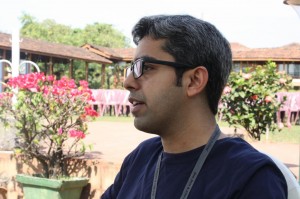
DWL Readers’ Club launches in Islamabad


Hurray! We’ve always sort of considered Islamabad our home city, and now, with the launch of the DWL Readers’ Club in the capital, it seems things have come full circle.

The club’s Islamabad icebreaker managed to gather more interested readers than any other chapter had managed so far! This can only indicate good things to come.

If you’d like to sign up for the DWL Islamabad Readers’ Club or for our activities in Islamabad in general, write in to islamabad@desiwriterslounge.net.

In the meantime, here’s an awesome post that writer/photographer Haroon Riaz put up on the inaugural Readers’ Club session in Islamabad. Thanks, Haroon!


NAPA International Theatre Festival 2014 – Ismat Apa Ke Naam


NAPA Ismat Apa Ke Naam

There were two standing ovations that night at the NAPA auditorium in the old Hindu Gymkhana. The audience first rose to its feet when Naseeruddin Shah walked onto the stage to introduce the production, a dramatic retelling of three of Ismat Chughtai’s plays by Motley Theatre, titled Ismat Apa Ke Naam. That ovation was for Shah alone, fueled by the audience’s deep respect for his work in film, and their utter delight at seeing him in the flesh.

IMG_72316904199163

Photo credit: Syed Junaid Ahmed.

This production was an experiment of sorts, Shah said in his introduction. The storytellers would employ a mix of narration and acting, with basic use of props, lighting and sound, thus creating a more full-bodied storytelling experience. Karachi audiences had previously seen a simpler version of this being put into practice by Qissah Farosh, which had inserted a basic component of acting in their performance of the works of Patras Bukhari and Mirza Farhatullah Baig, but had stayed faithful to the narrative form of storytelling. Prior to that, Zambeel Dramatic Readings had paid tribute to Ismat Chughtai’s work in a more classical narrative style.

The benefits of the evolved storytelling model are obvious: it allows the narrator to interact with the audience, to react to the material while relaying it, and to laugh off mistakes – all the while maintaining the ambiance of a theatrical production. And so we saw Heeba Shah give a wide grin when she briefly stumbled at one point in her telling of Chhui Muee, a scathing critique of gender and class relations seen through the prism of childbirth. We saw Ratna Pathak Shah stop mid-sentence and chastise an audience member for leaving their cell phone on while narrating Mughal Bacha (originally published as Ghoongat), a funny and also incredibly sad lesson on love and ego. And we saw Naseeruddin Shah chuckle frequently through his telling of Gharwali, a hilarious literary treatise on the patriarchal concept of honour. Of course, given Shah’s skill as an actor, it is perfectly possible that the chuckling was intentional, but the point remains that the storytelling model allowed him to use it.

Over the course of an hour and some minutes, the three actors enthralled the audience with their charged performances. My only peeve was that Mughal Bacha was narrated in too low a voice; the audience had to strain to hear Ratna Pathak Shah. But Ratna Ji also served us one of the evening’s most memorable scenes, in which she prepared to say her prayers while building up to the climax of the story. The quiet, deliberate movements with which she performed the wuzu and wrapped her head scarf created an aura of both piety and dread as we waited to hear what would ultimately become of Kaalay Mian’s and Gori Bi’s unfortunate marriage.

It was testament to the strength of Chughtai’s writing and Shah’s direction that the theatrical aspects of the production never overpowered the stories. It seemed as though the Shah family was simply the channel; ultimately it was Ismat Apa whose voice emerged the strongest – unapologetic, unflinching – and that was exactly how it should have been.

NAPA Chairman Zia Mohyeddin with Naseeruddin Shah and Ratna Pathak Shah. Photo by Fawad Khan.

NAPA Chairman Zia Mohyeddin with Naseeruddin Shah and Ratna Pathak Shah. Photo by Fawad Khan.

The second standing ovation of the night came when the actors converged on stage to take their bows. By this time, the applause was not just for Naseeruddin Shah. All three actors had, in their own way and style, owned the stories they had told. They had truly celebrated Ismat Chughtai, and in doing so they had done us a service. As Shah had pointed out in his introduction, Chughtai never got the recognition she deserved in her own country. Despite her obvious literary talents and diverse body of work, she forever became known as the woman who wrote Lihaf. The stories showcased in this production demonstrated that Chughtai was never one to step back from difficult themes, but the mere implication of lesbianism in Lihaf had caused a scandal that she was never quite able to overcome in the course of her career, or indeed even after she died. Every time Motley Theatre performs Ismat Apa Ke Naam, it reclaims some of the space, inch by precious inch, that should legitimately have been hers. And for that we are grateful.


The NAPA International Theatre Festival 2014 is on ’till 27th March. Get details for the event here.

The Pink City magic and literature

Guest post by Kiran Nazish


Jaipur: It was all about sensations. It was about the exuberance of sounds, emotions, noise, feelings, aromas, color, joy and an irrepressible vivacity. There seemed to be thousands of people around; people who’d come from Bombay to Kolkatta to Pune to Goa to the US and London, all of them just readers and fans of literature. The sounds of laughter and loud, excited conversations drowning out the beeper-machine at the entrance.   I walked inside, under a canopy of colorful, Rajastani-style umbrellas hanging from the sky, and into the big lawn where it all was going to happen.

JLF umbrellas

Image copyright: Kiran Nazish.

JLF Mohammed Hanif car

M. Hanif featured on artist Rohit Chawla’s installation ‘Out of the Box’. Image copyright: Kiran Nazish.

There was no other place to be that morning. This was the biggest literature festival in the world and it looked like it. Built on a smaller festival that had started indigenously in the ‘pink city’ of Jaipur, the restyled Jaipur Literature Festival was launched by author William Dalrymple in 2006 as the first free literature festival in the world; also perhaps one of the most celebrated, judging by the increasing numbers of attendees. This year the festival broke records by bringing in 220,000 listeners across five days.

No wonder he's so happy. William Dalrymple swinging it while Reza Aslan looks on at a musical performance. Image copyright: Kiran Nazish.

No wonder he’s so happy. Dalrymple swinging it while Reza Aslan looks on at a musical performance. Copyright: Kiran Nazish.

The smell of hot adrak (ginger) chai wafted soothingly through the fresh winter air of Jaipur, in the front lawn. Crowds of people were seated on chairs and on the ground, standing, some on heels, peeking over each others’ heads to catch a glimpse of the tremendous Nobel Prize winner and economist Amartya Sen, who gave the key note address at the festival opening. Sen’s keynote address outlined a seven-point vision for a better India, one that included a strong and secular right-wing party and that reserved more space for the arts and humanities in public life.

Adrak chai walas. Image copyright: Kiran Nazish.

Adrak chai walas. Image copyright: Kiran Nazish.

Seats filled to capacity for Amartya Sen's address. Image copyright: Kiran Nazish

Seats filled to capacity for Amartya Sen’s address. Image copyright: Kiran Nazish

The hundreds of thousands of attendees listened to about 260 panelists spread across 175 sessions. Luminaries like novelist Jhumpa Lahiri, celebrity novelist and film maker Xiaolu Guo, philosopher Michael Sandel and classicist Mary Beard engaged hundreds in every hall simultaneously.

The programs at the festival were diverse, with leitmotifs of discussions on a variety of different topics, from the US troop withdrawal in Afghanistan to CIA’s war on terror, from female voices and women’s rights to India’s disappearing languages. The intriguingly-titled session “Who will rule the world?” had Professor Rana Mitter of the University of Oxford laying out China’s incontrovertible candidacy for superpower status. Sessions like “Democracy Dialogues” that included the author of “Why India Votes,” discussed India’s current challenges and new developments as a democracy.

Jonathan Franzen’s session with author Chandrahas Choudhury. Image copyright: Kiran Nazish

Jonathan Franzen’s session with author Chandrahas Choudhury. Image copyright: Kiran Nazish

The stunning Durbar Hall, full to capacity. Image copyright: Kiran Nazish.

The stunning Durbar Hall, full to capacity. Image copyright: Kiran Nazish.

This was the Jaipur Literature Festival’s biggest and most successful year to date, leaving participants with high expectations for next year’s event.


Kiran Nazish is a Pakistani journalist and academic, who currently teaches journalism at a university in India.

DWL interviews Bilal Tanweer at GALF 2013

The scatter here is too greatOnwards with our exclusive coverage of the IV Goa Arts and Literary Festival!

Somewhere between sessions and panel discussions, we caught up with Pakistani writer Bilal
Tanweer who was launching his debut novel The Scatter Here is Too Great at GALF 2013. Bilal is a writer, teacher and translator. He holds an MFA in Writing (Fiction) from Columbia University, and is the founder of the fantastic LUMS Young Writers Workshop and Short Story Contest, now entering its third year. The Scatter Here is Too Great was published by Random House India in November 2013.


Farheen Zehra (FZ)         Tell us a little about the book and the title. Why “The Scatter Here is Too Great”?

Bilal Tanweer (BT)           Among the various themes of the novel, one of the themes is our need to tell stories. My book is composed of short inter-related stories, through which I have tried to make sense of Karachi’s reality. Life in this city is overwhelming and I think we use stories to make sense of our own stories, which is a major theme of the book.


(FZ)        The blurb on your book says, ‘This is a love story to Karachi’. Is it really, and if so, why?

(BT)        We travel to many cities but there is always one city inside us that we care about the most, which becomes a primary reference point for us to make sense of the world. For me that city is Karachi. It is the city I care about the most. But it is also a madly, ruinously complex city and one may never find a story that does complete justice to it.


IMG_8212(FZ)        Have you focused on any particular area of Karachi or written about it as a whole?

(BT)        Karachi is such a huge city that it is impossible to think of the complete picture. My narratives are as limited as they can possibly get. Each story is from the point of view of a particular character. The first story is from the P.O.V of a child from a middle class family. Then there is one sketch of a boy from Nazimabad. The book depicts stories of everyday people living in the chaos that is Karachi and I hope readers from Karachi might be able to relate to the stories.


(FZ)        So who is your intended audience?

(BT)        I think the whole question of ‘audience’ is very muddled.  As a writer, I’m not focused on the audience. The reality of publishing is that the people who are paying you to write are abroad. In my case, all my intellectual training is in English but that doesn’t mean I was thinking of a reader in New York while writing the book, because that reader can never understand Karachi the same way.  As far as I’m concerned, I am the first and foremost audience of my work.


(FZ)        Why launch the book at GALF?

(BT)        The organizers invited me to launch my book here. It’s a great festival with brilliant conversations on the margin so I think it was a very appropriate setting for my book launch.  Also, I love Goa. It makes me think of Karachi of yore, which comes as no surprise as both the cities share strong connections and similarities.


The Scatter Here is Too Great is the DWL Karachi Readers’ Club’s first read for 2014.


Once Upon a Macaroon: London Readers’ Club Inaugural Meet

by Zainab Kizilbash Agha


‘What really knocks me out is a book that when you’re all done reading it, you wish the author that wrote it was a terrific friend of yours and you would call him up on the phone whenever you like it. That doesn’t happen much, though.’ J D Salinger


Yes. How nice if we could pick up and call Jane Austen to ask for Mr. Darcy’s number or ask Yann Martel to end our misery and tell us whether that tiger in Life of Pi was made up or ask Kamila Shamsie for the achaar gosht recipe from Salt and Saffron or hang out with Ngozi Adichie and tell her how cool she is. But since we cant call Kamila or Yann or Ngozi (and certainly not Jane) I guess the next best thing is to find other people who get excited about books and, well… get excited about them together.

And that is why I kept stalking DWL facebook posts to ask when we would have a DWL Reader’s Club meet in London, until one fine day the DWL voice replied, ‘When you organize it, my dear’ and I went away skipping and jumping at the thought of a readers’ meet finally happening in London (as did the DWL voice, I am sure).

So for its first meet the DWL Readers’ Club in London (from now on referred to as the London meet) chose to discuss Hosseini. Of course at that point the ‘DWL Readers’ Club in London’ consisted only of me and Sonal (who had been volunteered to co-organise this event) and our choice was the result of some careful thinking.

Me: ‘Who should we talk about?’

Sonal: ‘Hosseini.’

Me: ‘Why?’

Sonal: ‘I just got his latest book.’

Me: ‘But DWL Dubai is already starting off with that one. Okay, okay… let’s be different and talk about all his books!’

Sonal: ‘Haan. Good idea. We could talk about what people think about the characters he creates.’

Me: ‘Haan haan. Clever.’

Sonal: ‘And look, here is a picture of all three of his books together that we could use to advertise the meet.’


Hosseini seemed to work as we eventually got twenty-four people signed up for the meet. True that some of them didn’t live in London, nor even the same time zone, and most of them shared either one of my last names, but that was all mere technical detail. We were going to have this meet, even if I had to bring my kids to help fill up the seats (although their response to his  books had been pretty lukewarm  – ‘But mama you can’t really have a thousand suns’).

Fast forward to 2:59 pm on the day of the meet and Sonal and I could be found staring forlornly at a plate of macaroons dutifully shaped in the letters ‘D’ and ‘L’ (we used sugar packets for the ‘W’… those macaroons are expensive!).  Our back-up plan, if no one came, was to yell ‘free macaroons!’ and snap lots of pictures when people stampeded to our table.
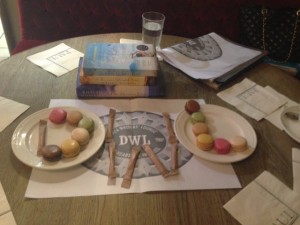
photo (3)

Thankfully people did show up.

I spotted Harsha first, struggling behind the long queue trying to get into the café. I went to bring her to the table, greeting her enthusiastically. She politely asked how I had managed to recognise her, considering we had never met. I shrugged noncommittally (how could I explain that she would recognize people too if she had stalked their page a few times to determine the probability of them turning up at this meet?).  And then after Harsha came the others, filling our table to capacity. These included a real writer (yes, yes, the cool factor of our meet went up a notch or two) and a DWL regular who has been to DWL Karachi meets.

I had anticipated that the conversation of a group that had never met before would be full of starts and stops, so had come armed with sheets full of ice breakers. But this was a group of women who were ready to chat. After a few minutes of ‘so which of his books have you read?’ and ‘how do you know about DWL?’ I discreetly dumped my sheets of paper under the table before anyone could spot my lame whose-line-is-it-anyway-type ice breaker questions about characters from the book.  A little introduction about DWL, Papercuts, a plea about the Indiegogo campaign, and we were ready to talk Hosseini.
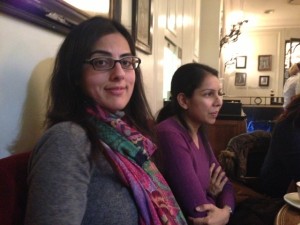
photo (5)

Most people had read his first book, some his second and a couple of us his third book, so the conversation focused on themes of his books rather than specifics (note to self and Sonal: for next meet choose one book so everyone talks about the same writing).

As this was Hosseini, the first word to go around the table was ‘depressing’. For some of us, though, his writing was sad but also showed that life was resilient – his characters went right on living and growing through all the tragedy. We went through the characters in his book, noting how they were impossibly human in their capacity for good and bad. A question we asked was whether the women in his books were stronger than  the men. Anqa passionately disagreed, saying that Mariam was shown just as human as her father, for example, in her initial relationship with Laila. We spoke about how the relationship between fathers and sons and their capacity to disappoint each other was a recurrent theme in his books and how legitimacy and gender played into the story lines.
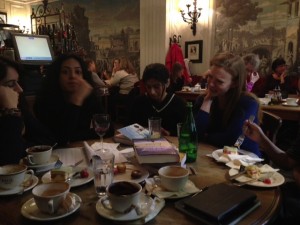
photo (4)

Holly felt that The Kite Runner had the weakest protagonist she had ever come across. Ayesha felt that although Hosseini fleshed out real characters, he didn’t do so well in describing how they felt.  Perhaps this was because of his first profession as a doctor:  he gave us the diagnosis but let us work out our feelings for ourselves. The doctors around the table nodded their heads vigorously on that one.

Inevitably the conversation turned to Afghanistan and the fact that Hosseini made this country accessible to the world at the right time. We discussed whether he was qualified to write about Afghanistan, a country he left when he was only ten. But all of us around the table agreed (strongly) when Harsha said that it takes one to leave a country to see it and experience it more clearly as she felt about India, having left a few years ago.  Perhaps that was why he was able to describe so beautifully what Amir would feel like when he went back to Kabul to find his family home before he went back himself (something he describes as ‘life imitating art’ in the foreword to the tenth edition of the Kite Runner).

We discussed how one’s own personal context has an impact on how one feels about a book. A few of us around the table felt that our threshold for pain was much lower than where it was a few years ago. For books that had recently made us laugh, Moni Mohsin’s  and Shazaf Fatima Haider’s work was cited. Sonal wondered if the things that made us sad were universal but the things that made us laugh were more culture specific. I suggested it was also because humorous writing is so difficult – it demands that the writer writes only what the reader wants to read rather than what the writer wants to write.

photo (6)

On the same note, Nigham suggested that the next London meet should be on a lighter book. ‘What?’ I thought, ‘They want to do this again!’ and my facial muscles (which had not sagged throughout the meet) hoisted themselves up even more. Somewhere quieter perhaps, Ayesha suggested, and we nodded as the waiters hovered around us to release space to the Covent Garden crowd, which leant, half frozen, against the café’s doors.

And that is how our first London meet ended: appropriately, with plans about the second.  To find out more about when that will be, and what book we will be reading, please email london@desiwriterslounge.net or watch the DWL facebook page.  To find out whether any one showed up (again) watch this blog!


DWL shines at GALF Day 2

Even though our journey to Goa was fraught with drama (read Omer’s post Goa, Goa, Gone for details) our first session was a success. DWL started off its first day at the Goa Arts and Literary Festival with a performance by Nimra Bucha and Adnan Jaffar of the play Yesterday An Incident Occurred, by Mark Ravenhill.

The play, with its dark humor and satire, went down very well with the audience and both the actors were commended on their performance. Initially the play was to be performed at the Inaugural Gala but it was postponed at the very last minute due to lack of time. But as our crazy 24 hour journey to Goa taught us, all’s well that ends well, and we were very pleased with the positive response from the audience. Kudos to Nimra and Adnan for putting up such a great show!

DSC_0240

DSC_0242

DSC_0247

DSC_0246

Goa, Goa, Gone!

DWL is in Goa for the IV Annual Arts and Literary Festival. Our group has been invited to attend as a Festival Partner. Guest post by Omer Wahaj (Managing Editor – Papercuts) peppered with some local vernacular.

Goa, Goa, Gone!

A strange and hectic account of several different places at several different times. 

5th December, 3 am, Dubai Airport

On our way to Goa but still in Dubai.

We have miles to go before we reach Mumbai.

We started from Karachi, with our guests Nimra Bucha and Adnan Jaffar. Afia forgot her Indian immigration papers so she had to stay back. Adnan, Farheen, Nimra and I made it to the flight out of Karachi but we couldn’t make our flight out of Dubai. JetAirways, being the Jut Airways that it is, left us high and dry, even though we ran a 400 meter marathon and almost beat Usain Bolt’s record trying to reach the counter half way across the United Arab Emirates. We were waiting at the Emirates transfer desk to get our tickets sorted when Afia strolled in and said, “Hello guys…” like nothing to it.

This is us goofing around at the Dubai airport.


5th December, 1 pm, Mumbai Airport

After finally reaching Mumbai, we had to take a bus ride from the international terminal to the domestic terminal, which took so long that for a minute I thought that the domestic terminal might be in Goa only.

6th December, 1pm, Goa

Reached Goa last evening. Something went awry and Adnan and Nimra couldn’t perform as per schedule. They’re doing it today at 3pm itself. A sitar/tabla/drums band tore it up in the auditorium. Amazing music.

Will be live tweeting some events and seminars. Keep yourself posted with @desiwriters #DWLinGOA


SALF 2013 – Closing Night: Addictive Cities

Guest post by Zainab Kizilbash Agha


Panel: Amit Chaudhuri (author, Professor of literature at East Anglia) and Jeet Thayil (poet, author, musician)

Moderated by: Ted Hodgkinson (British Council Literature)

Date: November 1st, 2013


photo (1)


The South Asian Literature Festival ended its 2013 programme with an event interestingly titled as ‘Addictive Cities’. There are some cities – cities like Calcutta, Karachi and Bombay – that have drawn writers back repeatedly and that have helped writers tell the stories they want to tell, while in turn the writers have wound up telling the stories of the city.

Even though it was a particularly wet evening, and a Friday, the room was filled to capacity with people in welly boots, waterproof jackets and slightly wet green saris. In the session, a little longer than an hour, Ted Hodgkinson conversed with  two authors who have had particularly monogamous relationships with their cities: Amit Chaudhuri, author of various books set in Calcutta including The Immortals of Calcutta;  and Jeet Thayil, poet and author of Narcopolis, which is a story of Bombay experienced through opium addiction.

Ted cleverly used the mundane details of life in each author’s writing to engage with them on bigger ideas – identity, religion, modernity and Indian cosmopolitanism.

Both authors agreed that they liked to ‘flip’ reality in their writing and show readers a different perspective on things.  For example, both tended to show the urban, man-made landscape as more natural than the rural one. For Jeet, this battle between urban and rural was like a match between the writings of Baudelaire and Wordsworth. The city won, he said, because only it could make people truly anonymous, and therefore it was ‘the only place where freedom was possible’. Bombay, in particular, interested Jeet because of the way the city warmly accepted all kinds of people in a truly democratic way, rewarding nothing but talent.

To explain his fascination with Calcutta, Amit read a passage  that  praised the city’s essential modernity, talking about the sense of timelessness that Calcutta embodied – not in the grand, formal way of mausoleums, but embedded in the patina that covered the streets, in its ‘aura of decay’ and the ‘slated windows that have stood forever’. “True modernity is not anything new,” he pointed out.

Jeet also read part of the prologue to his book, which started with ‘Bombay, which obliterated its own history by changing its name […]’. He rejected the use of Mumbai, he explained later in response to a question, because it was a deliberate political construct by people ‘who don’t read books and never will’. Amit added to this by explaining that the word ‘Kolkata’ did not exist in English other than as a utopian literary term just like ‘Calcutta’ seemed to have no meaning in Bengali.

The conversation continued on many different themes, one of them being the defining characteristics of good writers. According to Jeet, romantic poets were particularly to blame for making writers believe that they had to live a certain lifestyle – full of blistering relationships, drugs, alcohol and an assortment of other addictions – to be able to write, with the result that they become too busy leading that life to actually write. He read out a poem he wrote as a letter to Baudelaire after he won over his twenty-year drug addiction, admonishing the French poet for pushing him towards drugs. Ted offered him the poem on a paper to read out. Jeet declined and read it from memory and the audience got to see the performance poet at his best. There were laughs as Amit checked his recitation against a copy of the poem on a page in front of him.

The evening ended with a question about Calcutta and what the city meant for the Bengali identity. Amit said that as a child, Calcutta would speak to him about his Bengali identity through children’s fiction. He went on to explain how many serious writers of adult Bengali fiction, including Tagore, wrote a quota of children stories. This project to invest in Bengali children’s literature began in the 19th century and stretched ‘till today. Indeed, what better wayto help a child’s identity develop than through good stories? A future DWL project perhaps, I thought, as the evening and the Festival closed with promises of more to come next year.


Zainab Kizilbash Agha works in the public sector trying to improve how governments spend money and the choices they make. She has worked  with governments in Pakistan, Namibia, Ghana and now works in the UK. She writes for therapy. Some of her rants are here:

http://zhkizilbash.wordpress.com

Khayaal Festival of Arts & Literature 2013 – First day

By Fatima Hafsa Malik, DWL Events Coordinator, Lahore


When I decided to attend Khayaal Network’s literature and art festival a couple of weeks ago, I expected to enjoy myself.

What I didn’t expect was to be blown away.

A two-day event at Al-Hamra Theatre, it lived up to its promise, at least for me.

Regrettably, I could not attend on Sunday but the four sessions that I did attend were nothing short of brilliant. I could only make it to the afternoon sessions after work and so when I walked into Hall 1 at 2.30 or so, Mira Sethi’s session with Mohsin Hamid was already underway.

Mohsin_Hamid_in_conversation_with_Mira_Sethi

Mohsin and Mira in conversation

Mohsin is one of my favourite Pakistani authors and his was a talk that I had been looking forward to the most when I saw the schedule. And he did not disappoint. He was supposed to talk about English fiction and the Pakistani imagination, but he and Mira covered so much more. When asked which one of his three novels was his personal favourite, he said they were like his children but perhaps the latest one was the closest to his heart, although Moth Smoke being his first work of fiction would always be special. Talking about How to Get Rich in Rising Asia, he said that it was his attempt at a ghazal. And that he wanted to write about love like it has been written about in Sufi poetry, referring to the beloved in the ‘you’ form and lifelong love affairs. He said he wanted to explore what a non-transactional love would be like, what it would be like when you say to somebody that you love them and instead of meaning that they make you less lonely, if you meant that you would like them to be less lonely whether or not that includes you. When wrapping up before the Q and A portion, Mira asked Mohsin what his hopes and dreams were for Pakistan as a writer and a Pakistani. He said quite simply, ‘I don’t need much actually. I would be happy if Pakistan became a place where people stopped killing each other so much.’ Enough said, wouldn’t you agree?

Salman_Shahid

Salman Shahid in action

The next session was ‘Main Manto’ with readings by Sarmad Khoosat and Salman Shahid. How does one even begin to talk about Manto and the sheer impact of his genius? And how does one appreciate the talent of the two speakers who chose such different pieces and transported you to another world altogether? Suffice to say that I had goose bumps by the end of both readings. Salman Shahid read a short story by the name of ‘Thanda Gosht’ and if you haven’t read it yet, you must. A punch to the gut in typical Manto style, it was a very powerful

Sarmad in an uncharacteristically serious pose

Sarmad in an uncharacteristically serious pose (photo credit: Express Tribune)

reading. And Sarmad Khoosat simply stole the show. He read a letter of Manto’s and the resounding applaud he received after the reading was an honest testimony to the effect he had on the listeners. After the two readings this session also included the screening of a short teleplay by the name of Main Manto. And let me tell you, the audience was mesmerized. There was a hushed silence throughout the hall while we watched the life story of Manto play out before our eyes. It had a star studded cast including Sarmad Khoosat as Manto himself, Saniya Saeed as his wife and Arjumand Rahim, Mahira Khan, Faisal Qureshi among others. I think it deserved a standing ovation. And when it ended, I realized for the hundredth time how lucky we are to have such amazing talent amongst us.

The session after that was ‘Literature and Culture – a Discussion between Khaled Ahmed and Intizar Hussain’ and it was great listening to these two veteran writers talk at length about the Urdu language and the effect literature has had on our culture. They were both of the opinion that literature has suffered at the hands of politics and extremism. Intizar Hussain remarked that the beauty of the Urdu language lies in that it has been born from many languages and we must acknowledge that fact to appreciate it.

Bilal Lashari applauding in the 'Lights, Camera, Action' session

Bilal Lashari applauding in the ‘Lights, Camera, Action’ session

The last session for the day in Hall 1 was ‘Lights Camera Action’ and it had a few members from the teams of both ‘Waar’ and ‘Mai hoon Shahid Afridi’ who were interviewed by Shahnaz Sheikh. I haven’t watched either movie and so it was an interesting session for me as I had no opinion about them. And as proud as I am of the effort that has gone into both these films, the session seemed a bit ‘promotional’ to me. Maybe that was intentional, who knows. The audience seemed divided about the movies as well, some completely thrilled with them and others not so much. When asked why Waar was in English, Bilal Lashari said it was easier to promote at an international level and that it had subtitles. ‘But a large percentage of the population cannot read, Bilal,’ someone said, to which he replied that people still seemed to connect to the movie in spite of the language barrier and it had had a lot re-watchers in theatres. My take? Why not have English subtitles? Aren’t a lot of international movies in their local languages? Is it a reflection of the gora complex that seems to have ingrained itself inside us? Or am I reading too much into this?

All in all, it was a very intellectually appeasing day for me and I had a foot wide grin when I walked out of the complex to head home. There were a few technical glitches during the teleplay screening but it was worth the disruption. The attendance could have been better in my opinion but it was still heartening to see Lahoris of all ages turn out for a literary adventure. I am sure everyone who attended it had a great time and to all those who didn’t, mark your calendars for next time. It wasn’t an event to be missed!


Fatima Hafsa Malik alternates between medicine and writing. She can be found at www.fatimahafsamalik.blogspot.com and @fhafsamalik